- THE FIT PICKLER
- Posts
- Owning The Transition Zone
Owning The Transition Zone
Win $200, Playing In The Cold, Line Calling, DUPR Expands,Cruises, TV Shows, Volleys At The NVZ & More

FIT PICKLER
December 11, 2025
Health, Fitness, News & Fun for Picklers of All Ages
What's Cooking in the Kitchen This Week:
Still time to WIN $200 Survey Contest Is Still Live!
Owning The Transition Zone
Why You're a Half-Second Slower on Cold Mornings
The “Clockwork” Dinker Pickleball Drill
Fitness Expert Glenn Dawson: The Y's The T's and The I's
MLP Partners With Owl AI For Automatic Line Calling and Challenge System In 2026
APP And USA Pickleball Move To New Platforms Thus Solidifying DUPR Rating Dominance
Pickleball Debuts On Holland America Line’s Relax Away, Half Moon Cay
Celebrity Pickleball Series 'The Wager,' Hosted by Jason Kennedy, To Begin Streaming Later This Year
Coach Mary: Two-Handed Backhand Vs. One-Handed Backhand Volley At The NVZ
SURVEY CONTEST
Yes, We Still Need Your Help!
Please take 3 Min. to fill out our
Survey! On Dec. 18th we will
choose TWO Winners
from the survey submissions
EACH Will Receive a $200 Amazon
Gift Card Delivered To Your Email

Help us help you! Every year we survey our readers to find out what is important to them. Not just content in the Fit Pickler but in your day to day life. This information helps us bring you the best content and allows us to keep The Fit Pickler newsletter a FREE resource to celebrate recreational play. Thank you in advance!
If you filled out this survey out when you subscribed after Nov. 15th, you are already entered to win! (We will filter out duplicate submissions.)
We’ve already took action on your answers so far and added a dedicated Drills Of The Week column. We really need and heed your input!
Go here to fill out the survey: TAKE THE SURVEY NOW
🥷 SKILLS
Owning The Transition Zone

Signed, Sealed, Returned!
If there is one part of the court that makes players panic, it is the space between the baseline and the kitchen. Miss one ball there and the rally unravels. Freeze there for a moment and the opponents take over instantly.
The transition zone is not a danger zone. It is a workspace. Your job is to move through it in control so you can reach the kitchen on your terms. Once you understand what to do between the lines, the middle of the court stops feeling chaotic and starts feeling manageable.
What the Transition Zone Actually Is
The transition zone is the open court between the baseline and the kitchen line. You move through it after your return, during your third and fifth shots, and while recovering from pressure. Players struggle here not because the space is inherently unsafe, but because they enter it without a plan. Your approach is simple. Move in stages. Hit a neutral ball. Then move again. If you are returning serve, consider starting a few feet behind the baseline so you can step into the return and still send it deep. That extra margin gives you better depth and cleaner footwork during the first steps into transition.
The Three Big Transition Mistakes
💪 Health & Fitness Section
Weekly Advice To Keep You Fit & Injury Free


BRRRRRRRing It On
Why You’re A Half-Second Slower On
Cold Mornings (& How To Get Your
Reflexes Back)
You see the ball coming.
Your brain says, "Move!"
But your paddle arrives late. Your feet feel stuck. And that volley you'd normally crush sails past you before you can react.
You shake it off. Must be rust.
But then it happens again. And again.
Here's the thing: it's not rust. And you're not losing your edge.
Cold weather literally slows your nervous system. Your muscles. Your reflexes. Even your brain.
But once you know why it happens, you can fix it in about 90 seconds – and get back to playing fast, sharp, and confident, even when it's freezing out.
Why Cold Makes You Slow
Your nerves send signals slower
Your nerves are like electrical wires. When they're warm, signals fly. When they're cold, they crawl.
Studies show nerve conduction speed drops when your skin and muscle temperatures fall – even by just a few degrees. For players over 50, that tiny slowdown is the difference between a clean volley and a paddle that gets there late.
Your muscles contract slower
Cold muscles take longer to fire. That means slower footwork, slower paddle prep, slower reaction to anything fast at the net.
It's not weakness. It's physics.
🚀 New Section:
DRILL OF THE WEEK
The ‘Clockwork’ Dinker Drill

What Time Is It? Time To Dink
Focus: Dinking Consistency & Unforced Error Reduction
We’ve all been there: you’re in a long, patient dink rally, and then it happens—an unforced error. The ball hits the top of the net or floats just a little too high, ending a point you worked hard to construct. Winning at the kitchen isn't about power; it's about unwavering consistency.
The problem: practicing dinks can feel unproductive without a partner, and it’s easy to get bored just hitting against a wall.
The “Clockwork Dinker” fixes that. It’s a solo wall drill with three distinct levels of progression that builds machine-like consistency, touch, and directional control—turning mindless reps into a focused, skill-building game.
Setup
All you need is a wall, a ball, and some tape. No partner, no court required.
• Net Line: Create a line on the wall at net height (36 inches). • No-Fly Zone: Add a second line two feet above the first. Your goal is to keep every shot within this window.
How the Clockwork Dinker Works
The drill is broken into three levels, each designed to build on the last, from pure form to advanced directional control.
• Beginner (The Metronome): Focuses on perfect, repeatable form.
• Intermediate (The Juggler): Builds continuous rallying skills.
• Advanced (Around the Clock): Develops pinpoint accuracy under pressure.

🏋️ STAYING FIT with
GLENN & BRIANNA
The Y’s, The T’s & The I’s
🗞️ NEWS
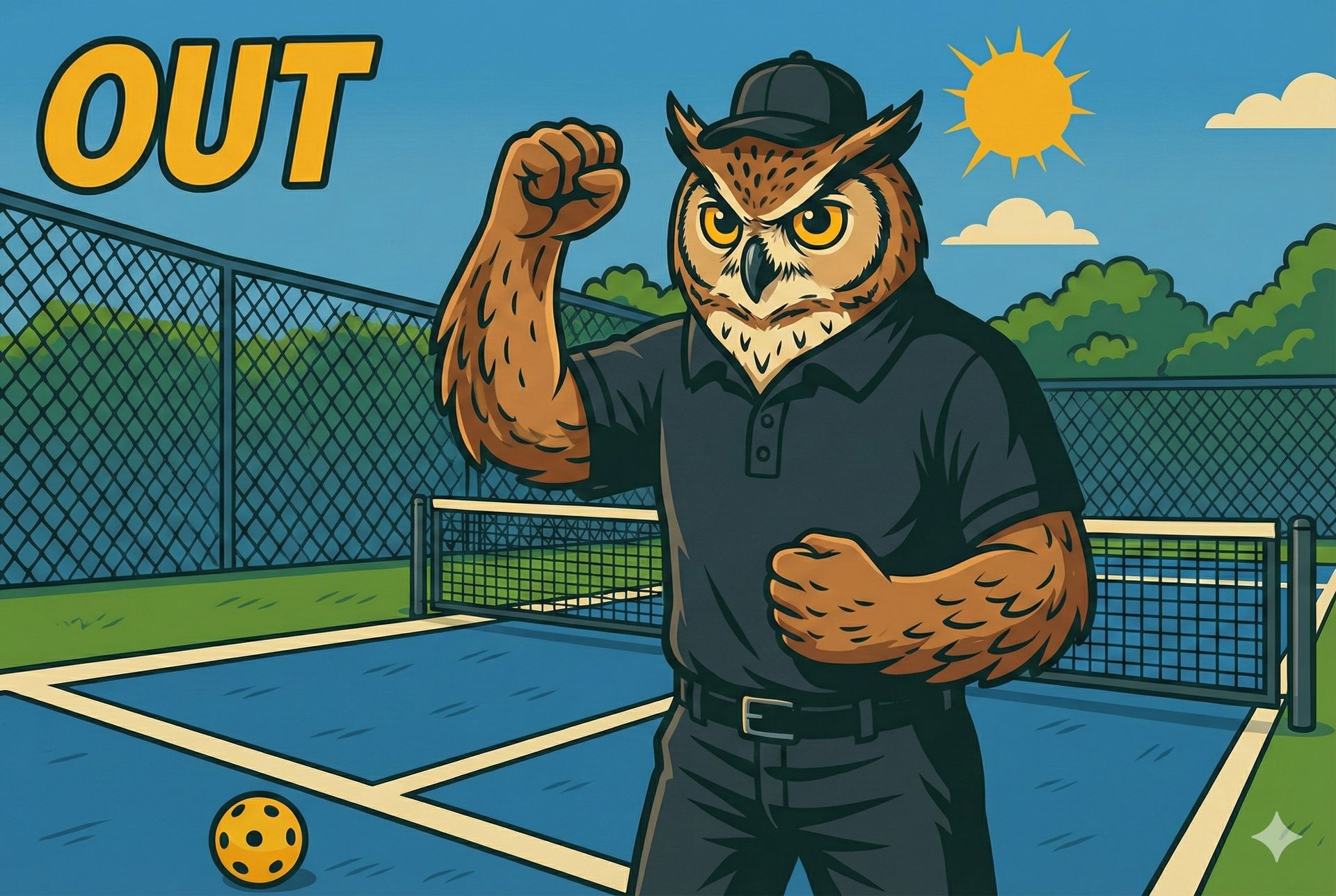
Whooooo Said That Was Out?
MLP Partners With Owl AI
For Automatic Line Calling &
Challenge System in 2026
Major League Pickleball is taking a huge tech leap for 2026, partnering with Owl AI to bring automatic line calling and a revamped challenge system powered by generative AI and computer vision. Faster rulings, more accuracy, and a more transparent fan experience—all without the pricey hardware other sports rely on.
Want to see how this could reshape officiating, broadcasts, and the pace of pro pickleball next season? Check out the full announcement for what’s coming.
🗞️ NEWS
APP & USAP Move To New Platforms
Solidifying DUPR Rating Dominance
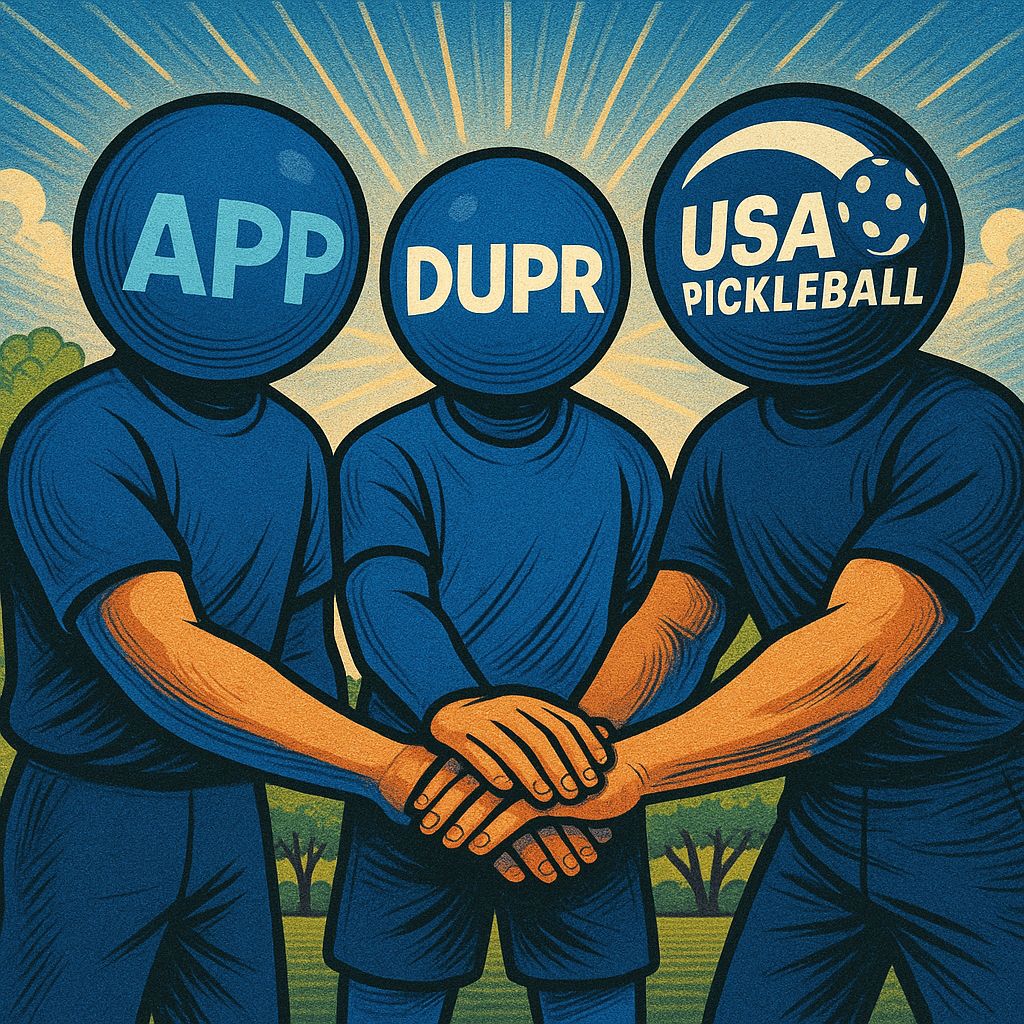
Dominance For DUPR?
A major shakeup just hit the pickleball world: USA Pickleball and the APP are shifting platforms, and the move effectively cements DUPR as the sport’s dominant rating system going into 2026. With two of the biggest organizing bodies redirecting their event data, the entire competitive landscape is about to feel the ripple effect.
Want to understand what changed, why it matters, and how it could impact every player from pros to weekend warriors? Check out the full breakdown, read more here…
🛳️ TRAVEL NEWS
Pickleball Debuts On Holland America
Line’s Relax Away, Half Moon Cay
Holland America Line just turned its private island, Relax Away, Half Moon Cay, into a mini pickleball paradise with four new courts added right on the sand, plus refreshed cabanas, more loungers, and expanded beach activities. As the PPA’s first cruise-line partner, HAL now lets you play pickleball on the ship and on a Bahamian private island in the same trip.
If cruising and court access both matter to you, check out how Half Moon Cay’s new pickleball setup fits into upcoming Caribbean sailings and sea-day routines, click here…
🤩 CELEBRITY NEWS
Celebrity Pickleball Series
‘The Wager’ Hosted By Jason Kennedy
To Begin Streaming Later This Year

The Wager With Jason Kennedy
Celebrity pickleball is getting the full TV treatment: “The Wager,” hosted by Jason Kennedy and featuring PPA pro Wes Burrows taking on actors and athletes in bet-driven pickleball matches, is jumping from regional sports networks to free streaming platforms like Roku, Tubi, Xumo, and Pluto. Fast games, fun stakes, and sideline storytelling make it part competition, part hangout.
Want to see who’s brave enough to put something real on the line with their pickleball game? Check out the preview story here…

🧭 COMMUNITY NEWS
RALLY RUNDOWN:
LOCAL HIGHLIGHTS
TUCSON, AZ: Will Pickleball Become A Sanctioned High School Sport?
SPOKANE, WA: A Look At Pickleball's Growth In Spokane
POMPANO BEACH, FL: New Pickleball Courts Open At Sgt. Kip Jacoby Park
TUSCALOOSA, AL: New Outdoor Pickleball Courts Open
DELRAY BEACH, FL: Sabatose Sets World Pickleball Record for Serves in a Minute
EAST BRUNSWICK, NJ: Massive Pickleball Club Will Transform A Former N.J. Mall Into A Sports Paradise
PLAINFIELD TOWNSHIP, MI: West Michigan township scores pickleball club project set to open in 2026
DALLAS, TX: Pickleball Brings New Life To Seniors At South Dallas Rec Center
DO YOU HAVE LOCAL NEWS TO SHARE? REACH OUT TO US AT
[email protected] and send us a link to your story!
HOLDING COURT with
COACH MARY
💪 Two-Handed Backhand Vs.
One-Handed Backhand
Volley At The NVZ

Two-handed backhand versus one-handed backhand volley at the NVZ. Which is better in different situations?
1. Con Garnett shows the basic grip and hand placement for the two-hander. This is step one.
· Garnett demos how to use your pointer finger on the back of the paddle.
· Also, he emphasizes getting a longer handled paddle if you are using a two-hander.
· Lastly, he stresses that the left hand, or non-dominant hand is the power source.
2. Callie Smith demonstrates the one-handed versus two-handed backhand volley.
Notice how much more she incorporates her core, hips and shoulders with the two-hander.
· One the one-hander, notice how her off hand/arm is thrown back as she strokes through the ball.
· Focus on watching her body and hip and shoulder turn on the two-hander, and the paddle position, low to high, follow-through over her shoulder on the two-hander.
3. Tanner explains how it is awkward and weak if you must reach away from your body with a one-handed backhand volley. He demonstrates how you can create more control and power with two hands.
· Important: if the ball is in towards your body, block or defend with a one-hander.
· If it is to the side, use a two-hander, unless it is out of your reach.
4. Zane Navratil demonstrates the pros and cons of the two-hander on volleys.
· Zane backups Tanner with the focus on two hands when to the side, and one hand when it is at your chest.
· I love when Zane demonstrates, because you can see the quick hands, the decision-making, and the reaction time. Watch it more than once!
5. In a second video with Zane and Jordan, Zane explains when you would use a one-hander rather than a two-hander with backhand volleys at the NVZ.
· Again, this is a back-up on using a one-hander when the ball is out of your reach, and when you must reach into the NVZ for a dink in front of you.
· Use a two-hander when the ball is 6 inches out from your hip. Watch his demo!
Note: When using a two-hander at the net, you must incorporate more hip and shoulder and core rotation. I use a two-hander on dinks, third shot drops, and sometimes on groundstrokes.